

Transforming Higher Education: The Strategic Promise of AI Tutoring Systems for HBCUs and Student Success in STEM
From Research to Reality - A Comprehensive Guide for Implementing AI Tutoring Solutions in Minority-Serving Institutions

In an era where educational equity and technological innovation intersect, artificial intelligence tutoring systems represent a transformative opportunity for higher education institutions, particularly Historically Black Colleges and Universities (HBCUs), to revolutionize STEM education and support undergraduate student success. As the global AI tutors market explodes from $1.63 billion in 2024 to a projected $7.99 billion by 2030[1], forward-thinking administrators and faculty must understand how these systems can address persistent challenges in student retention, personalized learning, and academic achievement while navigating the unique opportunities and barriers facing minority-serving institutions.
Professor Moustapha Diack is affiliated with the doctoral program in Science/Math Education (SMED), College of Science and Engineering (CSE) - Southern University A&M College - Baton Rouge, Louisiana
Understanding AI Tutoring Systems: Beyond Traditional Educational Support
Defining the Landscape: Rule-Based vs. Adaptive AI Models
AI tutoring systems fundamentally operate through two distinct paradigms that educational leaders must understand to make informed implementation decisions. Rule-based systems, the earlier generation of AI tutors, function through predefined if-then conditions created by experts in specific domains[2][3]. These systems excel in structured environments like mathematics, where deterministic rules can guide student interactions through predictable pathways. However, their limitations become apparent in subjects requiring interpretation or creative thinking, as they cannot adapt to scenarios lacking clear correct answers[4].
In contrast, adaptive AI models represent the cutting edge of educational technology, utilizing machine learning algorithms and natural language processing to create dynamic, personalized learning experiences[5][6]. These systems analyze vast amounts of student performance data, learning preferences, and engagement levels to tailor educational content in real-time. Unlike their rule-based predecessors, adaptive systems can handle ambiguity, provide contextual responses, and evolve their teaching strategies based on continuous interaction with learners[2].
Leading Platforms Reshaping Higher Education
The current marketplace offers several sophisticated platforms that demonstrate the practical application of AI tutoring principles. Khanmigo, developed by Khan Academy in partnership with OpenAI, exemplifies the potential of generative AI in education. Built on GPT-4 technology, Khanmigo provides unlimited, on-demand tutoring across subjects while maintaining pedagogical integrity by guiding students toward understanding rather than simply providing answers[7][8]. The platform's success lies in its ability to simulate one-on-one tutoring relationships while remaining accessible 24/7 at a fraction of traditional tutoring costs.
Learning Management System integrations represent another critical development pathway. Canvas has introduced AI-powered features including Smart Search capabilities that understand query context rather than relying solely on keyword matching, and Discussion Summary tools that help faculty manage large-scale student interactions[9][10]. Similarly, Blackboard's AI Design Assistant streamlines course creation through automated content generation, rubric development, and assessment creation while supporting pedagogical conversations through AI-powered Socratic dialogue tools[11][12].
Specialized platforms like STEMMIE focus specifically on STEM education challenges, offering instant assistance with complex mathematical equations, scientific concepts, and engineering problems through step-by-step explanations that promote critical thinking rather than rote memorization[13]. These domain-specific tools demonstrate how AI tutoring can address the particular challenges facing STEM students, who often struggle with abstract concepts that benefit from personalized, adaptive explanation strategies.
Transformative Applications in Higher Education
Personalized Learning at Scale
The most significant advantage of AI tutoring systems lies in their ability to deliver truly personalized education experiences to large student populations. Traditional higher education models struggle to accommodate diverse learning styles, paces, and backgrounds within standardized course structures. AI tutors address this challenge by continuously analyzing student interactions to identify knowledge gaps, predict learning outcomes, and adapt instructional strategies in real-time[5][6].
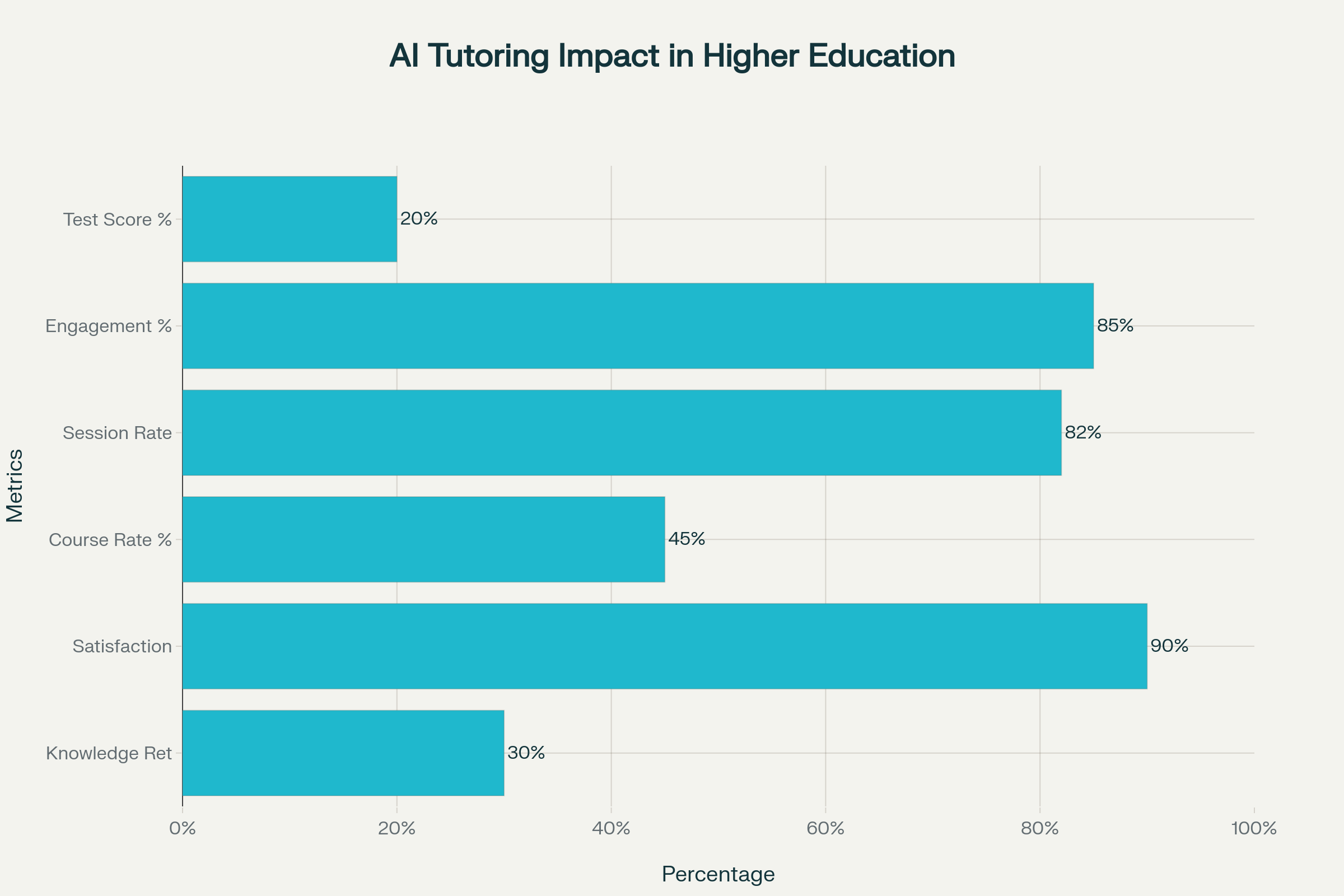
Research demonstrates remarkable outcomes from this personalization approach. Studies show that students using AI tutors scored an average of 20% higher on standardized tests compared to peers using traditional methods[14]. More importantly, these systems show particular promise for supporting students who might otherwise struggle in traditional classroom settings, providing the kind of individualized attention that can make the difference between academic success and failure.
24/7 Academic Support and Accessibility
One of the most practical benefits of AI tutoring systems is their constant availability, addressing a critical gap in traditional academic support services. Students often encounter challenging concepts or complete assignments outside regular business hours, when human tutors and faculty office hours are unavailable. AI tutoring systems provide immediate assistance, explanations, and guidance regardless of time constraints or geographical limitations[7][15].
This accessibility proves particularly valuable for non-traditional students who may work part-time jobs, have family responsibilities, or live in different time zones. For HBCUs serving diverse student populations with varying life circumstances, 24/7 AI support can significantly impact student persistence and success rates by ensuring that academic help is always available when needed.
Data-Driven Insights for Faculty and Administrators
AI tutoring systems generate unprecedented amounts of data about student learning patterns, engagement levels, and conceptual difficulties. This information provides faculty with detailed insights into how students interact with course material, which topics generate the most questions, and where curriculum modifications might improve learning outcomes[16][17].
For administrators, aggregate data from AI tutoring systems can inform strategic decisions about resource allocation, curriculum development, and student support services. Institutions can identify trends in student struggles across multiple courses, evaluate the effectiveness of different teaching approaches, and make evidence-based improvements to academic programs.
The HBCU Advantage: Leveraging AI for Educational Equity
Current HBCU Leadership in AI Education
Despite persistent narratives about resource constraints, many HBCUs demonstrate remarkable innovation in AI adoption and education. Morehouse College made history by becoming the first university to implement AI teaching assistants, launching fully functional 3D conversational AI tutors available 24/7 to students[18]. These AI teaching assistants can conduct office hours, provide assessment feedback, and offer multilingual support, directly addressing the diverse needs of HBCU student populations.
North Carolina A&T State University leverages AI to enhance STEM education through predictive analytics and personalized tutoring systems that identify at-risk students and provide targeted interventions[19]. Their approach demonstrates how AI can support the retention and success of underrepresented students in STEM fields, addressing persistent achievement gaps through data-driven personalization.
Howard University and other leading HBCUs have established dedicated AI labs and research centers, creating hands-on learning environments where students work on real-world AI projects[20]. These initiatives prepare students to become AI innovators rather than merely AI users, positioning HBCU graduates as leaders in the growing AI economy.
Addressing Unique Challenges and Opportunities
HBCUs face distinct advantages and challenges in AI tutoring implementation. The close-knit, supportive learning environments characteristic of many HBCUs create ideal conditions for introducing AI tutoring systems as supplements to existing mentorship and support structures. Students accustomed to personalized attention from faculty may more readily accept AI tutors when positioned as additional support rather than replacement technology.
However, resource constraints and infrastructure limitations present real challenges. The digital divide affecting many HBCU students means that AI tutoring implementation must consider varying levels of technological access and digital literacy[21][22]. Successful implementation requires comprehensive support systems that ensure all students can effectively utilize AI tutoring tools regardless of their technological background.
Building on Cultural Assets and Community Strengths
HBCUs possess unique cultural assets that can enhance AI tutoring effectiveness. The strong emphasis on community, mentorship, and student success creates an environment where AI tutoring can be positioned as an extension of existing support networks rather than a replacement for human interaction[23]. This cultural foundation enables more effective integration of AI tools that complement rather than compete with the personal relationships central to HBCU educational models.
Benefits and Challenges for HBCU Implementation
Educational Efficacy and Student Outcomes
Research consistently demonstrates significant learning improvements through AI tutoring implementation. Students engaging with AI tutoring systems show 30% improvement in test scores, 85% increase in engagement levels, and substantially higher retention rates[14][24]. For HBCUs working to improve STEM graduation rates and reduce achievement gaps, these outcomes represent transformative potential.
Adaptive learning capabilities allow AI tutors to meet students where they are academically, providing appropriate challenge levels without overwhelming struggling students or boring advanced learners. This differentiation proves particularly valuable in STEM courses where students enter with diverse mathematical and scientific backgrounds, requiring personalized approaches to achieve success.
Immediate feedback mechanisms help students identify and correct misconceptions before they become entrenched, reducing the likelihood of academic failure. Traditional classroom settings often lack sufficient opportunities for real-time feedback, allowing students to develop incorrect understanding that becomes increasingly difficult to remediate over time.
Cost-Effectiveness and Resource Optimization
While initial implementation costs require significant consideration, AI tutoring systems offer substantial long-term cost benefits. Analysis suggests that institutions can achieve returns on investment exceeding 4000% when factoring in improved retention rates, reduced need for remedial courses, and increased graduation rates[25]. For resource-conscious HBCUs, this represents an opportunity to dramatically improve student outcomes while optimizing operational efficiency.
Scalability advantages mean that AI tutoring systems can serve unlimited numbers of students without proportional increases in staffing costs. This enables HBCUs to provide high-quality academic support to growing student populations without correspondingly large increases in personnel expenses.
Professional development support for faculty represents another cost-effective benefit, as AI tutoring systems can provide data-driven insights that help faculty improve their teaching effectiveness and better understand student learning patterns.
Implementation Barriers and Mitigation Strategies
Despite significant benefits, HBCUs face real challenges in AI tutoring implementation. Infrastructure requirements including reliable internet connectivity, appropriate hardware, and technical support systems represent substantial upfront investments[26][27]. Successful implementation requires comprehensive planning that addresses these technological prerequisites.
Faculty training and change management present ongoing challenges as educators must develop new skills and adapt pedagogical approaches to effectively integrate AI tutoring tools. Research indicates successful implementation requires sustained professional development programs that help faculty understand both the capabilities and limitations of AI tutoring systems[28][29].
Digital equity concerns require careful attention to ensure that AI tutoring implementation doesn't exacerbate existing educational disparities. HBCUs must consider varying levels of technological access among students and provide appropriate support systems to ensure equitable access to AI tutoring benefits[30][22].
Ethical Considerations and Equity Frameworks
Addressing Algorithmic Bias and Fairness
The implementation of AI tutoring systems raises critical questions about algorithmic bias and educational equity that HBCUs must address proactively. AI systems trained on historical educational data may perpetuate existing biases that have disadvantaged underrepresented students, potentially undermining the very equity goals that drive HBCU missions[31][30].
Bias mitigation strategies require ongoing vigilance and systematic auditing of AI tutoring systems to identify and correct discriminatory patterns. This includes ensuring diverse representation in training data, implementing fairness metrics in system evaluation, and maintaining human oversight of AI decision-making processes that affect student outcomes[32].
Culturally responsive design principles must guide AI tutoring implementation to ensure that systems recognize and build upon the cultural assets that students bring to their learning experiences. This requires moving beyond one-size-fits-all approaches to develop AI tutoring systems that can adapt to diverse cultural contexts and learning traditions[23][22].
Data Privacy and Student Agency
AI tutoring systems generate vast amounts of data about student learning patterns, personal struggles, and academic performance. This raises important questions about data ownership, privacy protection, and student agency in educational decision-making[31][33]. HBCUs must establish clear policies governing data collection, storage, and use that prioritize student privacy while enabling beneficial uses of learning analytics.
Transparency requirements demand that students understand how AI tutoring systems make decisions about their learning experiences and maintain agency in those processes. This includes providing clear explanations of AI recommendations, enabling student choice in AI tutoring usage, and maintaining human oversight of consequential educational decisions[34][35].
Maintaining Human Connection and Educational Values
Perhaps the most critical ethical consideration involves preserving the human relationships and mentorship opportunities that define quality higher education experiences. AI tutoring systems must complement rather than replace the personal connections between faculty and students that drive engagement, motivation, and personal development[36][37].
Human-in-the-loop governance ensures that AI tutoring enhances rather than diminishes educational relationships by supporting faculty in providing more effective, personalized instruction while maintaining the irreplaceable human elements of education[38][39].
Strategic Implementation Framework
Institutional Readiness Assessment
Successful AI tutoring implementation requires comprehensive assessment of institutional readiness across multiple dimensions. Technology infrastructure evaluation must examine network capacity, hardware availability, and technical support capabilities to ensure that AI tutoring systems can operate effectively. This includes assessing student access to appropriate devices and internet connectivity, particularly important for HBCUs serving students with diverse technological resources[40][26].
Faculty preparedness assessment should evaluate current digital literacy levels, pedagogical technology integration experience, and attitudes toward AI-assisted instruction. Research indicates that successful implementation requires faculty buy-in and adequate training support, making this assessment critical for implementation planning[41][29].
Student readiness evaluation must consider digital literacy levels, learning preferences, and cultural attitudes toward technology-assisted learning. Understanding these factors enables institutions to design appropriate orientation and support programs that maximize AI tutoring effectiveness[40].
Phased Implementation Strategy
Best practices suggest a phased approach to AI tutoring implementation that begins with pilot programs in select courses or departments before expanding institution-wide. Phase One should focus on high-enrollment, high-difficulty courses where AI tutoring can demonstrate clear value in supporting student success. STEM courses often provide ideal starting points due to their structured content and clear learning objectives[40][42].
Phase Two expansion should build on initial successes while addressing lessons learned from pilot implementations. This phase should include comprehensive faculty training programs, student orientation initiatives, and refined technical support systems based on early experience[40][26].
Phase Three institution-wide implementation requires robust governance structures, comprehensive evaluation systems, and ongoing professional development programs to ensure sustainable success. This phase should also include integration with existing academic support services and institutional research capabilities[38][43].
Governance and Quality Assurance
Effective AI tutoring implementation requires comprehensive governance frameworks that address ethical considerations, quality assurance, and continuous improvement processes. Ethical review boards should evaluate AI tutoring systems for bias, privacy protection, and alignment with institutional values before deployment[44][45].
Quality monitoring systems must track student outcomes, system performance, and user satisfaction to ensure that AI tutoring systems achieve intended benefits without unintended consequences. This includes regular auditing of AI recommendations, evaluation of student learning outcomes, and assessment of faculty and student experiences[16][46].
Continuous improvement processes should incorporate feedback from all stakeholders to refine AI tutoring implementation and address emerging challenges. This requires ongoing collaboration between faculty, students, technical staff, and administrators to optimize system effectiveness and institutional impact[38][39].
Future Trends and Strategic Recommendations
Emerging Technological Developments
The AI tutoring landscape continues evolving rapidly, with emerging technologies promising even more sophisticated educational support capabilities. Multimodal AI systems that can process text, voice, images, and video inputs will enable more natural and comprehensive tutoring interactions. These systems will better accommodate diverse learning styles and provide more engaging educational experiences[47][17].
Integration with virtual and augmented reality technologies will create immersive learning environments particularly valuable for STEM education, allowing students to visualize complex concepts and conduct virtual experiments that would be impossible in traditional classroom settings[28][48].
Advanced predictive analytics will enable earlier identification of at-risk students and more proactive intervention strategies, potentially preventing academic difficulties before they become insurmountable challenges[49][17].
Strategic Recommendations for HBCU Leadership
Based on comprehensive analysis of current research and best practices, several strategic recommendations emerge for HBCU administrators and faculty considering AI tutoring implementation:
Start with Strategic Partnerships: Rather than attempting to develop AI tutoring capabilities independently, HBCUs should leverage partnerships with established technology providers and other institutions to share costs and expertise. Collaborative approaches can provide access to sophisticated AI tutoring systems while building institutional capacity for ongoing management and improvement[50][20].
Prioritize Faculty Development: Successful AI tutoring implementation requires sustained investment in faculty professional development that goes beyond technical training to include pedagogical integration strategies and ethical considerations. Faculty must understand both the capabilities and limitations of AI tutoring systems to effectively incorporate them into their teaching practices[28][29].
Emphasize Complementary Integration: AI tutoring systems should complement rather than replace existing academic support services and faculty-student relationships. The most effective implementations position AI tutoring as additional support that enhances rather than diminishes human connections that define quality higher education experiences[36][37].
Invest in Digital Equity: HBCUs must address digital access barriers that could prevent some students from benefiting from AI tutoring systems. This includes providing device access, internet connectivity support, and digital literacy training to ensure equitable participation in AI-enhanced learning opportunities[23][22].
Develop Comprehensive Governance: Implementing robust governance frameworks from the beginning of AI tutoring initiatives will prevent ethical challenges and ensure alignment with institutional values. This includes establishing clear policies for data privacy, algorithmic fairness, and human oversight of AI-driven educational decisions[44][38].
Conclusion: Seizing the Transformative Moment
AI tutoring systems represent more than technological innovation—they offer a strategic opportunity for HBCUs to address persistent challenges in STEM education while positioning themselves as leaders in educational technology implementation. The evidence demonstrates clear benefits in student outcomes, cost-effectiveness, and educational equity when AI tutoring systems are thoughtfully implemented with appropriate support structures and governance frameworks.
For HBCU administrators and faculty, the question is not whether AI tutoring will transform higher education, but whether their institutions will proactively shape that transformation or reactively adapt to changes driven by others. The institutions that act strategically now, building comprehensive implementation plans that address infrastructure, training, and governance needs, will be best positioned to harness AI tutoring's transformative potential for student success.
The journey toward AI-enhanced education requires careful planning, sustained commitment, and collaborative effort across institutional stakeholders. However, the potential rewards—improved student outcomes, enhanced educational equity, and institutional leadership in educational innovation—justify the investment required for successful implementation. As the AI tutoring market continues its explosive growth and sophisticated systems become increasingly accessible, HBCUs have a unique opportunity to leverage these tools in service of their foundational mission: providing transformative educational experiences that empower students to achieve their full potential and contribute to society's advancement.
The future of higher education is being written now, and HBCUs have both the opportunity and responsibility to ensure that AI tutoring systems serve the cause of educational equity rather than exacerbating existing disparities. By embracing this technology thoughtfully and strategically, HBCUs can continue their historic role as innovators in educational practice while preparing the next generation of leaders for an increasingly AI-driven world.
References Cited
2. https://talkpal.ai/unlock-learning-potential-with-khanmigo-ai-tutor-your-smart-study-partner/
3. https://www.canva.com/help/connect-canva-to-lms/
4. https://life.ieee.org/event/enhancing-stem-education-through-ai-assisted-tutoring/
5. https://bse.berkeley.edu/leveraging-ai-improve-adaptive-tutoring-systems
6. https://blog.khanacademy.org/ai-tutor-tutoring-khanmigo-kl/
7. https://instructionaldev.umassd.edu/lms-tool-integrations/
8. https://events.vtools.ieee.org/m/415849
10. https://blog.khanacademy.org/
11.
12. https://www.cs.cmu.edu/~bmclaren/pubs/OuyangEtAl-AIinSTEMEducation-EditedBook2023.pdf
13. https://www.cengagegroup.com/news/perspectives/2024/2024-in-review-ai--education/
14.
16. https://www.sistemtutoring.com/blog/meet-stemmie-your-ai-assistant-for-stem-learning
18. https://news.morehouse.edu/ai-teaching-assistants?utm_source=chatgpt.com
21. https://www.linkedin.com/pulse/transformation-higher-education-through-ai-hbcus-ivies-lee-bess-6xgac
22. https://educapes.capes.gov.br/bitstream/capes/921865/1/minorities-and-the-ai-revolution-an-ex.pdf
23. https://www.linkedin.com/pulse/metrics-kpis-ai-mentors-universities-iblai-3tkhe
24. https://f1000research.com/articles/14-299
25. https://www.edcafe.ai/blog/best-ai-tutors
27.
https://www.restack.io/p/ai-tutoring-answer-statistics-on-effectiveness-cat-ai
29. https://uncf.org/the-latest/five-uncf-member-hbcus-experiment-with-ai-tool-for-educators
31.
32. https://guides.lib.jmu.edu/AI-in-education/ethics
33. https://eurweb.com/2024/morehouse-college-to-introduce-ai-teaching-assistants-this-fall/
34. https://pdfs.semanticscholar.org/778d/7728919f0050424cfc7c0ac13989e8a6672c.pdf
35. https://pmc.ncbi.nlm.nih.gov/articles/PMC12179260/
36. https://libguides.unm.edu/AIinEducation/ethics
37. https://news.hbcusince.com/2024/07/ai-at-hbcus-the-undefined-future-of-education/
38. https://www.alicoalition.org/blog/minority-serving-institutions-are-key-to-a-stronger-r-d-ecosystem/
40. https://www.apadivisions.org/division-5/publications/score/2024/01/ethical-artificial-intelligence
41. https://canvas.web.baylor.edu/news/story/2024/new-canvas-ai-features
42. https://www.bu.edu/excellence/programs-services/academic-technology/ultra/ai/
43. https://dialzara.com/blog/ai-tutoring-implementation-6-step-guide-for-educators/
44. https://www.open-thoughts.com/2021/01/19/rule-based-vs-ai-adaptive-learning/
45. https://www.govtech.com/education/k-12/instructure-announces-host-of-ai-updates-for-canvas
46. https://github.com/DWE-CLOUD/Blackboard.ai
47.
48. https://its.uncg.edu/new-features-in-canvas-for-fall-24/
49. https://www.marshall.edu/ai/genai/blackboard-ai-design-assistant/
50. https://arxiv.org/pdf/2306.10052.pdf

Professor Moustapha Diack is affiliated with the doctoral program in Science/Math Education (SMED), College of Science and Engineering (CSE) - Southern University A&M College - Baton Rouge, Louisiana
AI4STEM is a free resource for our doctoral students, faculty, and education leaders exploring the power of AI.
💡 All content is openly accessible. If you believe in what we’re doing and wish to support this work, pledges are welcome — but never required.
🔗 [Subscribe for free or make a pledge](https://ai4stem.substack.com/subscribe)